Ceratizit CP.ISO12164-A63.SF.ER32.100.F CoreLine Prec. Collet Chucks Centro-P 84722621 (0832905)
Ceratizit CP.ISO12164-A63.SF.ER32.100.F CoreLine Prec. Collet Chucks Centro-P 84722621 (0832905)
Couldn't load pickup availability
Ceratizit Article Number: 84722621
Ceratizit Material Number: 8472262100
Ceratizit is a large tooling company based in Luxembourg (Europe).
This product is priced singly and comes in packs of 1.
Please note that the actual item may not be/look exactly the same as shown in the item picture(s).
| Properties | ||
|---|---|---|
| Name | Ceratizit CP.ISO12164-A63.SF.ER32.100.F CoreLine Prec. Collet Chucks Centro-P 84722621 | |
| EDP # | 0832905 | |
| Machine interface size | HSK-A 63 | |
| for collet | 470E (ER32) | |
| Clamping Ø, nominal, workpc. side - range / DCONWS | 2 - 20 | |
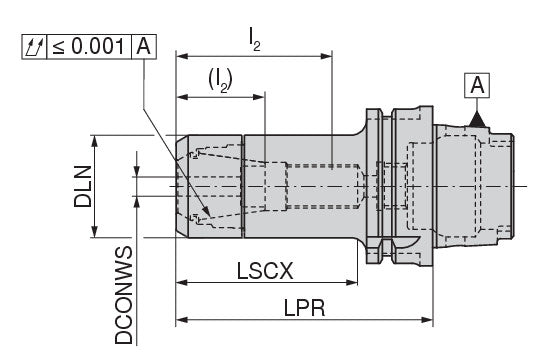
| Protruding length / LPR | 3.9370" | 100.000 mm |
| Diameter Lock Nut / DLN | 1.9685" | 50.000 mm |
| Neck diameter (BD) / BD | 1.9685" | 50.000 mm |
| Clamping length maximum machine side / LSCX | 2.7953" | 71.000 mm |
| L2 (L2) | 41 - 57 (26 - 39) | |
| Balance quality | G 2.5 n<sub>max.</sub>25000 | |
Background Information:
The HSK system was invented in Germany in the 1990's and is now very commonly found in European machine tools and spindles. HSK stands for "Hohl Shaft Kegel" - "Hollow Shank Taper", and as the name implies this type of interface has a cavity running through it. Unlike classical 'pull-stud' designs (CAT, BT, SK etc), HSK uses an internal drawbar mechanism which results in clamping force increasing with rotational speed. Additionally, the form features dual contact; on an axial face and the cone (1:10), which puts HSK in the upper echelons of tool holder performance.
The HSK-A form is probably the most common in the HSK family, and features drive slots which serve both to increase torque capability and provide rotational indexing (unequal slots). External features provide an interface for automatic tool change grippers and carousels. There is a bore milled directly into the side of the interface for RFID chip placement, and a threaded internal passage for coolant-through operation.
The ER tool holder system was invented by Fritz Weber, founder of Rego-Fix, and released in 1972. The ER-type system was originally used as a broom head to handle interface! The R in "ER" stands for Rego-Fix, and represents the company's modification to common "E" collet design of the early 20th century. Specifically, the modification was adding a groove to the collet which keeps it captive in the nut while installing/removing; eliminating the problem of collets getting stuck in the holders. Upon patent expiry the system was standardized in 1993 under DIN 6499 and is today the most recognizable and commonly used collet system worldwide.
The classic ER interface, tried and true.
Company History:
The company is a result of the merging of Metallwerk Plansee GmbH (Austria, 1921, later 'Plansee Tizit') and CERAMETAL (Luxembourg, 1931). The name Ceratizit was created by combining their names in 2002. Both founding companies originally produced molybdenum wire and tungsten lightbulb filaments, and were pioneers in commercial cemented tungsten carbide (since as early as 1929!) and their metal working / cutting tool product lines currently add up to over 80,000 items!
Share